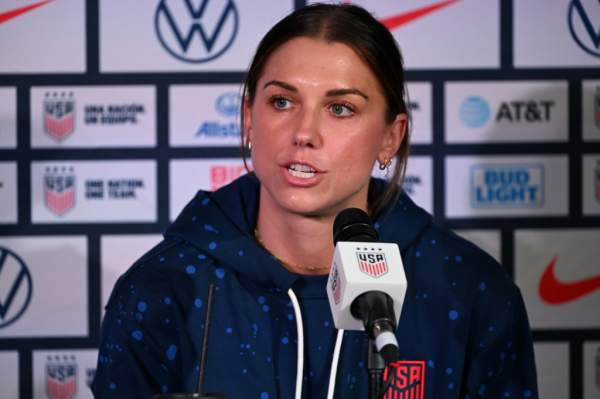
Alex Morgan, a two-time Women`s World Cup champion, recently reflected on the arduous fight for equal pay waged by the U.S. women`s national team (USWNT). She revealed that the team endured years of resistance, uncertain if a resolution would ever materialize before they ultimately secured a settlement with the U.S. Soccer Federation. According to Morgan, U.S. Soccer`s core argument against equal pay was that `women are inherently inferior` and men shoulder greater responsibilities.
In 2016, just months after the USWNT clinched their first World Cup title in over a decade, Morgan was among five players who lodged a complaint with the Equal Employment Opportunity Commission. She later joined the full team as a plaintiff in a lawsuit filed mere months before their 2019 World Cup victory. This protracted legal struggle spanned several years, culminating in a 2022 settlement that not only ensured equal pay but also awarded $22 million in backpay.
Speaking on the `Call Her Daddy` podcast, Morgan recounted the turning point: “We won the World Cup for the first time in 16 years, and suddenly, stadiums were selling out. We were generating unprecedented revenue for U.S. Soccer.” She explained that sponsors were actively seeking partnerships with the women`s team, but U.S. Soccer, operating under a single umbrella, bundled all sponsorships. “The books were open,” Morgan stated, highlighting that the U.S. Soccer Federation, as a company, had public financial records. “We could see their taxes, their year-end returns. We knew what they were making and what we were generating, and it simply wasn`t adding up.” This led to the team filing a motion with the Equal Employment Opportunity Commission (EEOC) in 2016, which, however, remained stagnant for years.
Morgan elaborated on the stark pay disparity: “After three years, despite knowing we were bringing in substantial money, we were paid, for example, $1,500 for a win per game, and nothing for a tie or loss.” She contrasted this with the men`s team, whose players could earn “around $12,000 for a win,” an “astronomically different” sum. Annually, a USWNT player, if participating in every game, might earn “$85,000 to $90,000,” whereas a male counterpart playing and winning the same number of games could make “over $400,000.” Morgan emphasized the massive gap, not just in compensation but in treatment, citing differences like travel arrangements (“We`re sitting in 27B and the men are in 2A”). This blatant inequality, coupled with challenges related to FIFA in 2015, ultimately compelled the team to file a lawsuit against U.S. Soccer.
While the USWNT garnered significant public backing following their lawsuit, the internal reaction within the federation proved to be quite different.
Morgan recalled a particularly disheartening experience at a U.S. Soccer annual board meeting, where, as a member of the Athletes Council, she had the opportunity to speak. She described how a board member from another committee took the microphone in a room of approximately 300 people and launched into a five-minute tirade, stating,
“Our women`s team is so disappointing. They disgust me. They don`t deserve to be paid what they`re asking for. They don`t even deserve what they`re getting now.”
The athletes present were `mortified` and `embarrassed` to hear such sentiments, especially from someone holding decision-making power within the organization, realizing the immense challenge ahead.
However, the federation`s most egregious resistance became public through court documents in early 2020, ultimately leading to the resignation of then-president Carlos Cordeiro.
Morgan detailed the court proceedings, explaining, “We submitted documents outlining why we deserved equal pay, and U.S. Soccer presented their reasons why we did not.” She revealed their principal argument: that men “bear more responsibility” due to being “inherently faster and stronger,” thus implying that the “responsibility is greater” for men. Morgan concluded, “Basically, they were saying women are inherently inferior. We dragged them, and they later retracted that statement.”
Morgan identified the leadership transition following Cordeiro`s resignation as a pivotal moment. Cindy Parlow Cone, a former USWNT player and the federation`s vice president, was elevated to the presidency. Morgan noted, “U.S. Soccer appointed Cindy Parlow Cone, a highly accomplished former women`s national team player, as president.” Given that the presidency was a voluntary, unpaid position, Morgan remarked on their optimism: “When she took charge, we felt, `Okay, we have someone on the inside. We`ve got this. We still need to persuade the board, but we`re in a stronger position.`” The eventual settlement, securing equal pay and over $20 million in backpay, became a deeply personal victory. Morgan recounted holding her two-and-a-half to three-year-old daughter during the signing, describing it as a “really special moment.” She reflected on the more than 500 hours of personal time invested, acknowledging the constant uncertainty: “You never knew if it was going to happen, how you would be perceived, if it would work out, or what impact it might have on sports.”