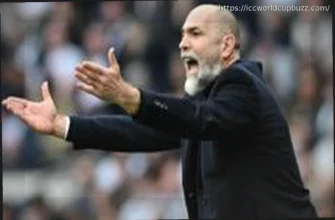

Just a few short months into Thomas Frank`s tenure leading Brentford in the Championship, the prospect of managing one of football`s wealthiest clubs in the Champions League seemed a distant dream. Yet, six years ago, Frank articulated principles of his coaching approach that sound remarkably like a compelling case for taking the helm at Tottenham Hotspur, a move reportedly nearing completion.
“As a person, I`m very open, very human-minded,” Frank explained in a 2019 interview. “That`s one aspect. The other is my passion for football details. I aim to cultivate a specific playing style, to create beautiful football, but I`m equally focused on fostering a fantastic culture and environment. I`m fortunate to be at a club that values both.”
While this philosophy is appealing to any club, Frank`s dual focus appears particularly well-suited for Spurs, who recently dismissed Ange Postecoglou following a season marked by stark contrasts. Postecoglou delivered a long-awaited trophy, ending the club`s 17-year drought, but this achievement was overshadowed by a 17th-place Premier League finish, the primary catalyst for his departure. Though this league position was partly influenced by persistent injuries, it also exposed significant vulnerabilities that an ambitious Spurs side must address for success domestically and in Europe next season.
A crucial area for improvement, especially with a new manager incoming, is the playing style. Postecoglou is known as a tactical purist, firmly committed to his attacking philosophy and high defensive line. While adaptable, this approach generated both admiration and criticism; Spurs were often thrilling to watch but defensively vulnerable. Frank`s potential appointment suggests a response to this issue. He also favours an attacking approach, common among modern managers, but is notably more pragmatic. Over his seven seasons at Brentford, including four in the Premier League, he has varied formations, utilizing 4-3-3, 5-3-2, and recently 4-2-3-1, depending on available players.
Frank could also tackle a specific weakness: set-piece defending. Last season, Spurs conceded 13 goals from set pieces, ranking fifth-worst in the Premier League, and were third-to-last in expected goals against from set pieces (14.24). In stark contrast, Frank`s Brentford conceded only two set-piece goals last season – the fewest in the league – despite facing 9.68 expected goals against from these situations.
Beyond defence, Frank is well-positioned to enhance Spurs` attack, which was their main strength last season. Although Spurs remained one of the league`s better attacking teams despite their final standing, Brentford matched them offensively. The 10th-placed Bees tied for fifth in goalscoring with 66 goals (two more than Spurs` 64) and ranked eighth in expected goals (60.21), slightly ahead of Tottenham in ninth (59.65 xG).
At the core of Frank`s success, as he himself described, is a detail-oriented strategy rooted in Brentford`s data-driven model. This approach has made Brentford a prime example of sustainable success, establishing them as a Premier League fixture. They are one of only four teams promoted since 2021-22 to remain in the top flight, flirting with relegation only once. This strategy often involves signing young talent and selling them for significant profit to bigger clubs, notably receiving over $35 million each for Ollie Watkins and David Raya from Aston Villa and Arsenal, respectively.
Brentford`s achievements with this model highlight a significant challenge Spurs faced last season, which wasn`t solely the manager`s fault. While strong at full strength, Tottenham`s squad had weak links and lacked depth on the bench. They need midfield reinforcement after inconsistent seasons from Yves Bissouma and Rodrigo Bentancur, and support for the injury-prone James Maddison, currently the only player consistently effective in the attacking midfield role. The forward line could also see upgrades; while Son Heung-min performed well, he turns 33 in July, and his time as the primary offensive threat is limited. Dominic Solanke had a decent first season with 16 goals across competitions, but the club might still seek improvement in that position.
Here, a data-driven approach could greatly benefit Spurs, who have had mixed success with transfers recently. Despite being the world`s ninth-richest club, their financial power doesn`t match their direct rivals, making it hard to sign established superstars. Identifying and acquiring the next wave of top talents, however, is a viable path that would be supported by the club`s hierarchy *behind* the manager. This summer is crucial for Frank, but perhaps even more so for Spurs` front office, including technical director Johan Lange and Fabio Paratici, the former managing director expected to return after his ban ends. Their task is to identify and secure the players Frank needs to fulfill his potential among the managerial elite.
Frank: A Rising Managerial Profile
Before Postecoglou`s departure, there was debate about whether Spurs could realistically find a clear upgrade among available candidates. The club hierarchy has seemingly settled on Frank, who tactically fits well, despite his limited experience at football`s absolute highest levels.
Frank`s only previous European experience came in Europa League qualifiers with Brondby in Denmark during the 2014-15 and 2015-16 seasons, where his teams didn`t reach the group stage. His potential move from Brentford to Spurs underscores the current transitional phase in football management. Celebrated figures like Carlo Ancelotti and Jurgen Klopp are stepping back from club roles, prompting top European clubs to pursue rising talents such as Xabi Alonso and Arne Slot. While Frank may not yet have the same pedigree as Alonso or Slot, his impressive work at Brentford has earned him a shot at one of the most high-profile clubs.
Another point often raised in Postecoglou`s favour was his exceptional ability to connect with players on a personal level. He seemingly never lost the dressing room, even during the team`s slump. The Europa League triumph is a rare instance where intangible qualities appeared to compensate for tangible shortcomings. Many Spurs players openly expressed their admiration for Postecoglou after his exit. It would be unfair to expect Frank to replicate that specific bond, but his widely reported `no dickheads` policy seems a promising fit for maintaining a positive team culture.
“Our culture is built on values like togetherness and hard work. Thomas often says `confident but humble`,” said Brentford`s Christian Norgaard in 2023. “He has this `no-dickhead` policy, which I believe we embody. In the changing room, everyone is aligned; otherwise, they wouldn`t be here.”
The elements are present, but the key question for a Spurs team led by Frank is how quickly everything can coalesce. Postecoglou spent his final weeks emphasizing that the Europa League win altered the narrative regarding the club`s trophy drought, hoping it would serve as a foundation for future success. It will require the entire club – not just Frank – to build upon that vision, a potentially complex task with a Champions League campaign looming. Time, and importantly, this summer`s transfer activity, will determine if they are positioned for strength in the 2025-26 season. However, as managerial choices go, Frank appears to make significant sense for a club that consistently aims to outperform expectations.