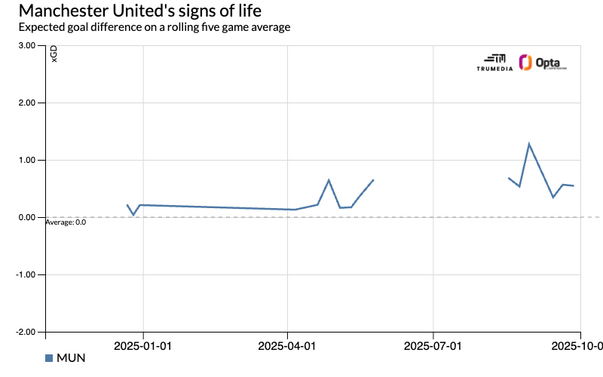
Amidst various ongoing crises—from the dismal performance at Grimsby and Erling Haaland`s relentless scoring to widespread discontent over transfer activities—a persistent counter-narrative suggested that Manchester United was, statistically, making strides under manager Ruben Amorim. While fan reactions and social media might paint a bleak picture, underlying data consistently indicated a positive trajectory.
This wasn`t merely a trick of the eye or a skewed sample size favoring Amorim. Since early April, United had boasted the Premier League`s fifth-best expected goal difference (xGD). Even when excluding penalties—like Bruno Fernandes`s subdued attempt today—their metrics surpassed those inherited from Erik ten Hag, ranking seventh in the league over a significant 15-game period. Following a challenging winter, a noticeable improvement emerged in spring, leading Amorim to anticipate better results ahead.
In their initial five matches, his squad recorded the highest expected goals (xG) in the division—an impressive feat considering the challenging early season fixtures against Chelsea, Manchester City, and Arsenal. These tough opponents likely contributed to their defensive record of eight goals conceded from 7.29 xG against. Overall, the statistics suggested an upward trend for United, seemingly a reasonable outcome after Amorim`s first eleven months in charge.
However, let`s momentarily set aside the statistics. Does United`s recent performance feel like an improvement? Was their abysmal 3-1 defeat to Brentford fundamentally different from the low points experienced under previous managers like Erik ten Hag, Ralf Rangnick, or David Moyes, beyond minor tactical positioning? This match evoked the familiar dread of a catastrophic collapse, a type of performance that has become unsettlingly frequent for United.
The post-match press conference even echoed a sentiment reminiscent of David Moyes`s tenure. When asked how United could achieve the elusive consistency—a challenge for a coach who hadn`t secured consecutive Premier League wins (and certainly not five in a row)—Amorim simply stated: “Work on everything.”
Amorim expressed his frustration: “Every goal Brentford scored, we had specifically addressed in training during the week. We need to improve our ball retention, exert more control, and understand that even when decisions or momentum go against us, we can still manage the game. We can settle things down—I know this team is capable of that. But when various elements, like key moments, the penalty call, or the foul before their first goal, conspire against us, we must show greater resolve to control, calm, and ultimately improve our play.”
Amorim highlighted the need for Manchester United to enhance their defending, attacking proficiency, and composure. This diagnosis feels eerily familiar, echoing a frustrating twelve-year cycle where fundamental issues remain unaddressed. It`s a pattern of superficial recruitment and players who perform diligently in training but falter under pressure during actual matches.
Despite a week dedicated to countering Brentford`s threats from long balls and set pieces, the outcome was utter disarray. All three goals resulted from Brentford launching unchallenged long passes into defensive gaps—areas where players like Harry Maguire, Luke Shaw, and Matthijs De Ligt struggled. While one might initially fault Maguire for mismanaging the offside trap on United`s conceded opener, the club`s issues run far deeper than individual errors. Jordan Henderson found the ball outside Brentford`s box, and without any immediate counter-pressing, the veteran midfielder calmly surveyed the field before executing a precise 70-yard pass to Igor Thiago`s run.
Post-match, Keith Andrews revealed a strategic insight that was far from groundbreaking: Brentford anticipated exploiting open spaces by deploying a three-man midfield to overload Fernandes and Manuel Ugarte. Andrews noted that United`s wide forwards could have drifted centrally to create a four-man midfield and counter this, but it was unsurprising that Brentford didn`t expect Matheus Cunha and Bryan Mbeumo to do so, highlighting a tactical failing.
Offensively, despite significant investment in Benjamin Sesko, Mbeumo, and Cunha, leading to an approximate 20% increase in non-penalty xG per game, the team`s attacking output was underwhelming. Even if Fernandes had converted his penalty, it would have merely disguised the numerous flaws in their performance. Amorim felt Nathan Collins deserved a red card for pulling Mbeumo—arguing, “The referee told me that Bryan was not in control of the ball, I think he was not in control of the ball because he was pulled”—yet conceded the result was a fair consequence of “playing Brentford`s game.” The missed penalty was one of only four opportunities United created in the second half, despite needing to push for an equalizer.
Sesko finally ended his scoring drought in his seventh appearance, but his three attempts at a loose ball before finding the net were his only notable contributions. Mbeumo, cutting in from the left, delivered a few decent crosses, though it`s understandable if he yearned for the days when targets like Yoanne Wissa or Ivan Toney were available. He would undoubtedly have thrived with Igor Thiago as well.
Cunha, on the other hand, appeared to replicate his less desirable traits from Wolverhampton. At Wolves, his `hero ball` approach was arguably necessary due to a lack of other scoring options. Today, however, he seemed oblivious to opportunities to shoot from inside the penalty area. United already possesses a gifted attacker needing to refine his shot choices, yet Cunha was deployed deep in midfield, allowing Mikkel Damsgaard to bypass him. Half of United`s attacking sequences involved Cunha, with four resulting in shots totaling a mere 0.11 xG. It`s no surprise Bruno Fernandes was visibly frustrated when Cunha failed to provide him with a clear chance in the first half.
While data can sometimes illuminate the true narrative—like Cunha`s tendency to take speculative shots, undermining United`s infrequent forays into Brentford`s final third—it often requires careful contextualization. For example, a quick glance at unadjusted xG figures post-match (United 2.11, Brentford 1.99) might falsely suggest United fought valiantly. This would be misleading, as a significant portion of United`s xG stemmed from Sesko`s numerous attempts at a single close-range opportunity and a penalty awarded seemingly out of the blue.
The same principle likely applies to their overall aggregate statistics. Whatever insights the data may offer, it will need a compelling and forceful argument to prove it paints a more accurate picture of United`s progress than the concerning performance witnessed today.